In a recent online discussion about video of video, one analyst argued that timing taken from a phone recording of a surveillance monitor is not acceptable for speed analysis. I respect that view, and the original file is always the better evidence. But I don’t think acceptable versus unacceptable is the most useful way to look at it. What I want to know is whether the analyst understands the limitations of the evidence and can put numbers to them.
For attorneys, that’s also a practical way to evaluate a video-based speed opinion, whether it comes from your own accident reconstruction expert or the other side’s. The questions below come out of our timestamp research (SAE Technical Paper 2025-01-8690) and my own casework. If some of the terms are new, the earlier posts in this series cover the basics.
1. Was the Original File Requested, and Why Isn’t It Being Used?
The native file is the video exactly as the DVR or NVR stored it. It carries timing information that a copy or a screen recording doesn’t. If the analyst worked from a heavily compressed copy (usually the result of the file being sent or exported improperly) or a phone recording, find out whether the original was ever requested. Ask about the digital chain of custody too, meaning who handled the file and how it got from the recorder to the analyst.
2. How Was Elapsed Time Determined?
In a native video, the timing data is stored within the metadata and can be accessed using forensic video analysis tools, such as Amped FIVE, Axon Investigate, or ffmpeg. That data often reports variability in frame timing. This timing data should be assessed against the movement within the frames. For instance, if there is variable timing reported in that data, and variable movement of objects in the frame, that would be a good sign. However, if the timing data reports constant timing and the objects are moving variably, that may be an indicator that the system’s timing data may not be accurate.
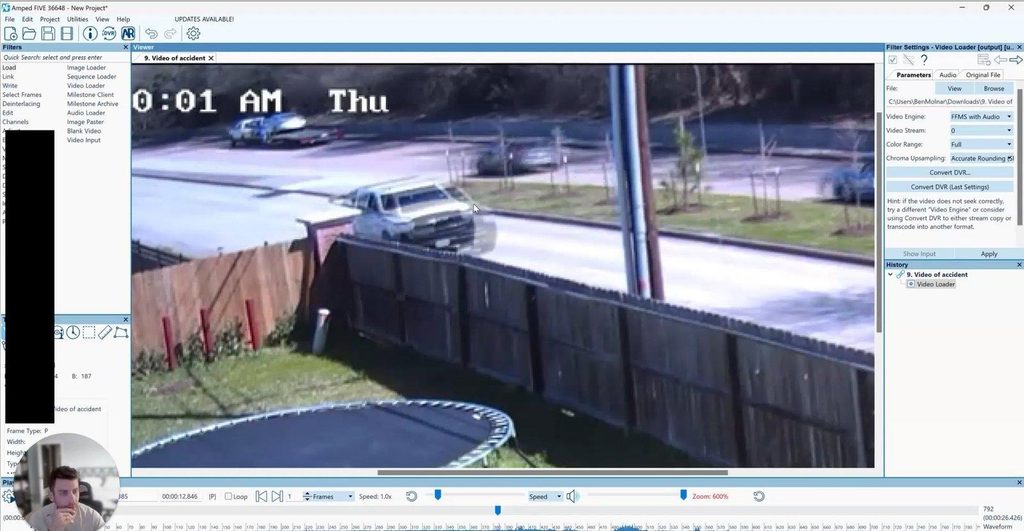
When the timing metadata appears inaccurate or you are working with a video of video, reading the clock in the corner at face value isn’t enough. In our testing, one second on the timestamp didn’t always equal one second of real time. The more reliable approach counts the frames within each timestamp second and applies the system’s average frame rate. Done that way, our average timing error was about 0.3%, with a worst case of about 2.2%.
Timing is more complicated than it looks. It is important to examine timing sources on a case-by-case basis and have a solid basis for whatever timing the analyst applies to the calculations.
3. For Video of Video, How Were Unique Frames Counted?
A phone filming a monitor usually captures each original frame more than once, and it often records a blended frame that mixes two original frames together. Ask how the analyst handled both, and how many seconds of video they sampled to establish the frame rate.
4. What Was the Recording Frame Rate?
Frame rate is how many pictures the system captures each second. At 4 frames per second, every system we tested alternated the spacing between frames instead of holding it steady, and that’s where our largest errors came from. A low frame rate doesn’t rule the video out, but the analyst should have addressed it.
5. Were Dropped Frames Considered?
Sometimes a recorder fails to save a frame, and nothing on screen tells you it happened. One sign is a vehicle that suddenly moves farther between two frames than it did between earlier ones. If the system is still in place and unchanged, a lightboard test can show whether it drops frames. If that is not an option, the analyst should carefully assess the provided video for dropped frames. Many times this can appear within the speed itself.
6. How Much of the Error Comes from Position Rather Than Time?
Timing is only half of a speed calculation. The other half is locating the vehicle in each frame, and that has its own uncertainty. Ask what the analyst used as the real-world reference for the scene, sometimes called control geometry. Laser scan data, drone photogrammetry and two-dimensional satellite imagery each have their own accuracy, and that affects how precisely the vehicle can be placed. Also ask whether the analyst accounted for lens distortion. Surveillance cameras often bend straight lines, especially near the edges of the picture, and without correcting for that the measurements can be quite flawed.
Ultimately, how the position error carries through depends on the method. A position off by a few inches may barely affect a speed calculated over a full second, while tracking the same vehicle frame by frame can compound it considerably.
7. How Is the Expert Reporting Speeds?
Speed from video is distance divided by time, which means the result is an average over the stretch of video analyzed. If the vehicle held a steady speed, that average describes what it was doing. If it was braking or accelerating, its speed at the start and end of that stretch will differ from the average.
That creates a tradeoff. Measuring over a longer stretch reduces the effect of small position and timing errors. Measuring over shorter stretches can reveal useful moments, like when braking started or when the driver steered, but each of those measurements carries more error. Ask the analyst what time interval each reported speed covers and how they balanced those two goals.
8. Does the Video Agree with the Rest of the Evidence?
This is the one I’d weigh most. Much like the limitations placed on event data recorder (EDR) data, video should not be analyzed in a vacuum. It’s one tool among many. The speed it produces should be checked against the EDR, momentum analysis, crush analysis and the physical evidence at the scene. If those don’t line up, the analyst should be able to explain why.
An analyst who has done this work carefully should be able to answer every one of these questions, and should already be reporting an error range alongside the speed.
Reference: Molnar, B., Terpstra, T., and Voitel, T., “Accuracy of Timestamps in Digital and Network Video Recorders,” SAE Technical Paper 2025-01-8690, 2025, doi:10.4271/2025-01-8690.
